


AI Label & Packaging Inspection: From Hidden Risk to Always-On Protection
Barcodes, ingredients, allergens, batch codes, expiry dates, QR links—modern labels carry far more than just branding. They are legal documents printed at line speed. One wrong line of text or missing allergen statement can turn a profitable product run into a recall, a brand crisis and a legal problem overnight.
Over the last few years, global data shows that product recalls are increasing, and label errors have become one of the biggest culprits—especially in food and beverage. At the same time, the market for vision inspection systems is growing strongly, as manufacturers realize that traditional human checks and basic sensors cannot keep up with SKU complexity and regulatory pressure.
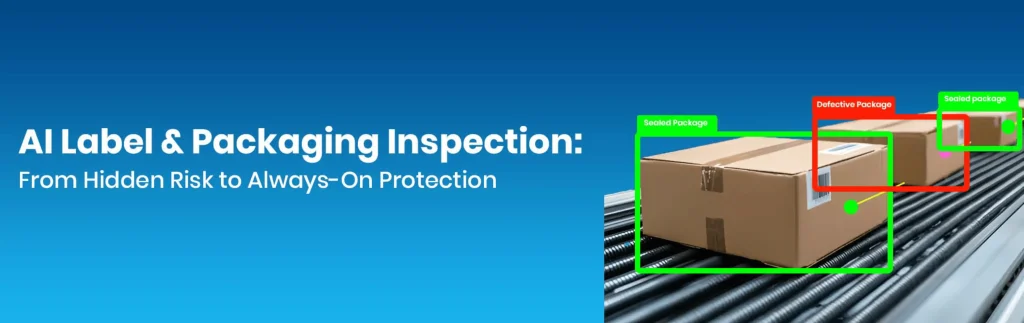
AI-powered computer vision is now stepping in as the “always-on auditor” for labels and packaging: inspecting every unit, verifying content and layout, and catching issues early enough that they never leave the plant.
1. The Recall Problem Behind Every Label
Before getting into technology, it helps to understand why label and packaging errors are now treated as board-level risks:
- Regulators and food-safety bodies report that undeclared or incorrectly declared allergens are the leading cause of food recalls in several regions, often representing around half of all recall events in a year. Many of these incidents come down to label mistakes rather than contaminated product.
- Analysis of U.S. FDA enforcement data for 2024 found that label errors accounted for roughly 45% of food recalls in that year, with undeclared allergens prominent among them.
- National food-safety agencies in countries such as Australia and New Zealand have also reported that undeclared allergens caused the largest share of food recalls, driven mostly by labelling problems rather than process failures.
- Industry and insurer studies put the average direct cost of a food recall at roughly eight figures in U.S. dollars for mid-to-large manufacturers, with individual recall events sometimes reaching tens of millions of dollars. These figures typically exclude indirect costs like reputational damage and lost customer trust.
- A global survey of manufacturers in 2024 and 2025 found that around three-quarters of respondents had experienced at least one product recall in the past five years, with a substantial share reporting recall costs in the tens of millions per event.
Taken together, these data points show that recalls aren’t rare “black swans”—they are recurring events in many portfolios. Labels sit at the centre of that risk.
2. Why Traditional Inspection Struggles on Modern Lines
Most plants today run faster lines, more SKUs and more variable packaging than they did a decade ago. Meanwhile, the tools for label verification often look the same:
2.1 Human visual inspection
Line operators or dedicated inspectors check random samples or watch a screen. Ergonomic and cognitive studies show that even trained inspectors can miss 20–30% of defects once fatigue and repetition set in, and typical manual accuracy is often quoted in the 60–85% range depending on conditions and complexity. That is nowhere near what is needed for allergen-critical labels.
2.2 Sample-based checks instead of 100% inspection
Even when procedures mandate that one in X packs be checked against a spec sheet, rare but dangerous misprints—like a wrong allergen declaration or misaligned barcode—can easily slip through undetected.
2.3 Rule-based machine vision only
Traditional vision systems rely on rigid rules and template matching. They struggle when:
- Artwork changes frequently
- Substrates vary (matte, glossy, foil, clear film)
- Text is small or curved
- There is minor label skew or stretching
Re-tuning and re-lighting can take days or weeks, making it hard to keep pace with marketing-driven packaging changes.
The result is a structural gap: throughput and SKU complexity keep increasing, but inspection methods do not scale, leaving a dangerous slice of risk sitting on the label.
3. What AI Label & Packaging Inspection Actually Does
AI-powered label and packaging inspection uses computer vision models—often deployed on the same or upgraded cameras already on the line—to interpret each frame in context. At a high level, a modern AI inspection stack looks like this:
1. High-resolution imaging
Line-scan or area-scan cameras capture the full label, cap and package at production speed, with strobing or controlled lighting to freeze motion and minimize glare.
2. Deep learning–based defect detection
Convolutional and transformer-based models detect visual defects such as:
- Missing labels
- Skewed or wrinkled labels
- Smudged or faint printing
- Misaligned artwork, logos and color bands
- Damaged tamper-evident features
3. OCR and OCV for all printed content
Optical character recognition and optical character verification engines read:
- Product names and variant descriptors
- Ingredient lists and allergen statements
- Nutrition panels
- Batch/lot and expiry dates
- Regulatory text and symbols
The system compares this content against product master data and approved templates, so even a label that “looks okay” visually but carries the wrong text or code will be rejected.
4. Barcode and 2D code grading
1D barcodes and 2D codes (QR, DataMatrix) are decoded and graded against standards. Poor print quality, low contrast or quiet-zone violations are flagged to avoid downstream scanning problems in logistics and retail.
5. Decision and integration
Based on configured rules and AI predictions, the system triggers:
- Hard rejections on the line
- Soft alerts and alarms to operators
- Logged events in MES, ERP or quality systems for traceability and analytics
Studies and vendor benchmarks now show that AI-based visual inspection can reach 97–99% detection accuracy for configured defect classes, while manual inspection regularly misses a significant fraction of issues. This is why more manufacturers see AI inspection as a core part of their digital quality roadmaps, not an experiment.
4. High-Value Use Cases Across Regulated Industries
4.1 Food & Beverage: Allergen, Date and Traceability Protection
In food and beverage, undeclared allergens and incorrect date codes are consistently cited as top recall causes. AI label inspection directly addresses this by:
- Checking that allergen statements and ingredient lists match the correct formulation for each SKU and market.
- Verifying best-before and expiry dates for both correctness and legibility, including laser and inkjet codes on necks, lids and bases.
- Ensuring barcodes and QR codes decode properly and meet minimum grade requirements, reducing retailer chargebacks and scan failures.
Real-world case studies from specialist vendors show beverage and food-processing plants using AI label inspection to significantly reduce labelling defects, eliminate mislabeled product from shipments, avoid recalls and improve production yield—often with payback periods under two years.
4.2 Pharmaceuticals: Zero-Defect Packaging and Audit-Ready Trails
In pharmaceuticals, a wrong batch code, missing warning, or unreadable UDI can have severe regulatory and patient-safety consequences. AI packaging inspection in pharma typically supports:
- Verification of GTIN, batch, serial and expiry on cartons, blisters and vials.
- Validation of GS1 and UDI codes against master data.
- Multi-language text verification for leaflets and cartons, even on small fonts and complex layouts.
- Inline capture of image evidence and decision logs for every batch, creating a strong audit trail.
Case studies in pharmaceutical vial and carton inspection report inspection cycle times cut by around a third, defect-detection accuracy above 97%, and double-digit reductions in manual inspection labor, all while meeting strict regulatory expectations.
4.3 FMCG, Personal Care & Household: Variant Control at High Mix
For cosmetics, personal care, and home-care brands, packaging is high-mix and marketing-driven. Frequent changeovers amplify risk:
- A mis-matched scent, shade or claim on the label can trigger returns and retailer penalties.
- Outdated claims or missing regulatory icons can cause compliance issues in specific markets.
AI inspection systems learn per-SKU layouts and color tolerances and can automatically switch “recipes” during changeovers. Vendors report that this approach reduces mix-up incidents and helps brands maintain consistent shelf appearance across markets and contract manufacturers.
4.4 Electronics & Industrial: Serialisation and Warranty Integrity
In electronics and industrial goods, labels often carry serials, MAC/IMEI numbers, safety marks and environmental symbols. AI-based label and code inspection is used to:
- Verify traceability codes against build records, ensuring each unit is uniquely and correctly identified.
- Check that safety and compliance icons (for example, CE, recycling, RoHS) are present and correctly printed.
- Detect label damage that might compromise downstream scanning, warranty claims or field service tracking.
This reduces rework, prevents orphan units in the field, and strengthens product genealogy for both quality analysis and warranty management.
5. Real-World Case Studies: Named Vendors, Clear Outcomes
Because many manufacturers keep their names confidential in public case studies, vendors often anonymize the clients. Even so, the outcomes are concrete and instructive.
5.1 Visionify – Inline Label Inspection for Beverage and Food Processing
Visionify has documented multiple deployments of AI label inspection systems:
- In a beverage-bottle inspection project, AI-powered label detection was used to automatically inspect labels on bottles in real time. The client reported significant reduction in labeling defects, improved production efficiency and elimination of costly recalls linked to label issues.
- In a food-processing inline label inspection system, a major food company implemented Visionify’s computer-vision solution to inspect every label on the line. The published case study states that the system achieved zero mislabeled products after deployment, resulted in zero recalls related to label errors, and produced a strong return on investment through higher yield and reduced scrap.
5.2 Pharmaceutical Inline Label Inspection – Zero-Defect Packaging
A documented case study on pharmaceutical packaging describes an automatic inline label inspection system for pharma products. By introducing AI-based visual inspection on the packaging line, the manufacturer:
- Achieved zero-defect packaging related to labeling and printing issues in the covered product range.
- Increased throughput while maintaining stringent regulatory compliance.
- Gained full image-based traceability of labels, which supports audits and investigations.
5.3 Cross-Industry AI Visual Inspection: Defects, OEE and ROI
Broader AI visual inspection case studies, though not limited to labels, show what kind of economic impact is possible when computer vision becomes part of core quality:
- A major steel producer using AI-based surface and defect inspection improved detection accuracy from roughly 70% to over 98%, generated annual savings exceeding USD 2 million, and realized an ROI close to 1900% in one year.
- Automotive component plants implementing AI visual inspection reported defect reductions in the high double digits, OEE improvements above 20%, notable downtime reductions, and 15–20% cost savings over a two-year horizon.
- Industry guides summarizing multiple deployments report defect-rate reductions of about 30%, inspection-speed gains of more than 20×, and 6× throughput improvements when AI inspection replaces or augments manual or basic automated checks—along with payback periods under two years and in some cases up to 30× reductions in inspection costs.
These numbers are not theoretical simulations; they come from real implementations and show what a robust AI inspection program can deliver.
6. Quantifying the ROI of AI Label & Packaging Inspection
For quality leaders and plant managers, the business case usually crystallizes around five levers:
1. Defect and recall risk reduction
When AI inspection pushes detection accuracy into the 97–99% range, while human inspection is known to miss 20–30% of defects, the residual risk of a mis-labeled product escaping drops sharply. For sectors where label errors are a leading recall cause, even a small reduction in recall probability can translate into millions in avoided losses over a few years.
2. Scrap, rework and complaint reduction
Catching label and print issues early on the line prevents pallet-level rework and downstream sorting. Vendors and integrators consistently report double-digit reductions in defect and scrap rates after AI visual inspection goes live.
3. Labor productivity and redeployment
Instead of having skilled operators visually check labels all shift, AI systems take over the repetitive checking. Studies and case reports mention inspection labor savings in the 15–20% range or more, allowing staff to focus on setup, troubleshooting and continuous improvement.
4. Line performance and OEE
Fewer stops for investigation, fewer false rejects and more stable inspection settings can improve both uptime and throughput. Case studies in general visual inspection point to OEE improvements above 20%, especially where false rejects previously caused frequent interruptions.
5. Compliance and audit strength
AI inspection systems log images and decisions for each unit or lot. This strengthens regulatory and customer audits by providing objective evidence of inspection, which is especially valuable in pharma and food.
When all five levers are quantified, many manufacturers find that the payback period for AI label and packaging inspection is in the 12–24 month range, sometimes faster when recall risk is high.
7. Implementation Roadmap: From Pilot to Network-Wide Capability
To move from PowerPoint to production, a structured rollout matters more than any single algorithm. A typical roadmap looks like this:
Step 1 – Map Risk and Critical-to-Quality (CTQ) Elements
- Identify where label and packaging errors have occurred historically (allergens, date codes, wrong variant, missing regulatory marks, unreadable barcodes).
- Define CTQ elements per SKU: which text, codes and graphics must be correct for the product to be legally and commercially acceptable.
Step 2 – Build a Defect Image Library
- Collect representative images of good labels and known defects: missing labels, smudges, misaligned artwork, wrong SKUs on the line, low-contrast codes, misprints after changeovers.
- Annotate these images by defect type and severity, creating the training set AI models need.
Step 3 – Design the Optical Setup and Compute
- Choose cameras, lenses and lighting so that the smallest character and symbol is resolvable at full line speed.
- Decide where inference will run—on smart cameras, edge GPUs or on-prem servers—to balance latency, bandwidth and IT constraints.
Step 4 – Integrate with PLCs, MES and Master Data
- Connect pass/fail signals to reject mechanisms, interlocks and alarms.
- Integrate with label-management systems, MES or ERP so that decoded text and codes can be validated against the correct master data for that job.
Step 5 – Pilot and Validate
- Run pilots on one or two lines, with challenger sets: deliberately seeded defects and controlled test runs to measure false reject and false accept rates.
- Use this phase to tune thresholds, refine models and prove that the system meets regulatory and internal quality requirements.
Step 6 – Scale Across Lines, Plants and Regions
- Standardize model versions, inspection “recipes” and naming conventions so the same logic can be reused across plants.
- Roll out a governance process for model updates, change control and retraining as new SKUs and regulations arrive.
Step 7 – Continuously Improve with Data
- Use dashboards to track top defect types, hotspots by line and shift, and early-warning indicators that precede larger issues.
- Feed insights back into design, procurement and process engineering so that fewer label issues are created upstream.
8. Where a Platform Like Objiq Fits
A platform like Objiq can act as the backbone for AI label and packaging inspection in three key ways:
1. Centralized data and annotation hub
- Store and manage millions of label, package and defect images from multiple plants.
- Provide collaborative tools for quality, packaging, and data teams to annotate and categorize defects consistently.
2. Model lifecycle and deployment management
- Train and version deep learning models for label presence, content verification, barcode grading and tamper-evident checks.
- Deploy models to edge devices or on-prem clusters with controlled rollouts, monitoring performance by plant, line and SKU.
3. Enterprise integration and governance
- Expose APIs and connectors into MES, ERP, PLM, labelling systems and quality platforms so inspection results flow into existing workflows.
- Maintain audit trails of model changes, training data and performance metrics to support internal governance and external audits.
Instead of treating each line as a separate project, manufacturers can build an enterprise-wide AI label inspection capability, with Objiq as the orchestrator—enabling faster pilots, repeatable deployments, and continuous learning across the network.
9. Key Takeaways for Quality, Packaging and Operations Leaders
- Label and packaging errors—especially undeclared allergens and incorrect information—have become a leading cause of recalls in food and other regulated industries.
- The cost of recalls often runs into tens of millions of dollars per event, and most mid-to-large manufacturers have experienced more than one in recent years.
- Traditional human and rule-based inspection methods cannot reliably catch every label error at modern line speeds and SKU complexity; research consistently shows manual inspection misses a significant fraction of defects.
- AI label and packaging inspection uses deep learning, OCR and barcode verification to inspect every unit at line speed, verify content against master data and log evidence for audits.
- Case studies from vendors like Visionify and others show zero mislabeled-product escapes, zero label-related recalls, major defect reductions, and rapid payback when AI inspection is rolled out properly.
- Platforms like Objiq allow organizations to scale this from one pilot line to a network-wide capability, turning label inspection from a weak spot into a competitive advantage and a serious layer of risk protection.