


AI Computer Vision for PPE Compliance and Worker Safety in Industrial Sites
Even in 2025, work still hurts far more people than most management dashboards show. International labour bodies estimate that close to three million people die every year due to work-related accidents and diseases, and hundreds of millions more suffer non-fatal injuries that keep them away from work for days at a time. Behind every number are damaged lives, shaken teams and disrupted operations.
At the same time, the market for environmental, health and safety (EHS) software is growing steadily in the high single to low double digits each year, reaching billions of dollars globally by 2030. That growth is a signal: organisations are under pressure from regulators, investors and employees to prove that safety is not just a poster on the wall.
Yet most safety programs still rely heavily on clipboards, spot checks and after-the-fact video review. PPE compliance is audited in weekly walks, unsafe acts are reconstructed from memories, and near-misses disappear into under-reported forms. AI computer vision changes that by turning cameras into always-on safety sensors.
1. The Scale of the Safety Problem (and Why PPE Matters)
Before talking about AI, it is worth grounding the scale of the challenge:
- Global estimates now put annual work-related deaths at nearly three million, with roughly 395 million non-fatal work injuries every year serious enough to cause at least four days of absence. A large share of these occur in higher-risk sectors such as manufacturing, construction, mining and logistics.
- In many countries, industrial accident rates remain stubbornly above global benchmarks, prompting governments to strengthen workplace safety laws, inspection budgets and penalties for repeat offenders.
- On the enterprise side, safety and EHS markets are expanding quickly. Recent forecasts place the EHS software segment alone in the low billions of dollars by the middle of this decade, with compound annual growth in the 7–11% range through 2030. In the United States, the wider EHS market size is already measured in tens of billions of dollars.
These numbers confirm two things: safety is still a structural global problem, and organisations are actively investing in digital tools and analytics to address it. PPE is one of the most basic—and most visible—layers in this stack. If your last line of defence is not reliably in place, everything above it is at risk.
2. What Is AI Computer Vision for PPE Compliance and Worker Safety?
AI computer vision uses video feeds and deep learning models to understand what is happening on the shop floor, in yards and on construction sites in real time.
Instead of a safety manager manually reviewing footage after an incident, AI continuously checks:
- Is everyone in the welding bay wearing the required PPE (for example, hard hats, face shields, gloves and high-visibility vests)?
- Are workers entering high-risk zones without helmets, goggles or hearing protection?
- Are forklifts and pedestrians mixing in “no-mix” zones?
- Are people climbing on racks, walking under suspended loads or crossing rail lines unsafely?
When non-compliance or unsafe behaviour is detected, the system can trigger alerts to supervisors, raise events in EHS software, or generate anonymised reports that show where risk is systematically higher.
AI safety systems typically include:
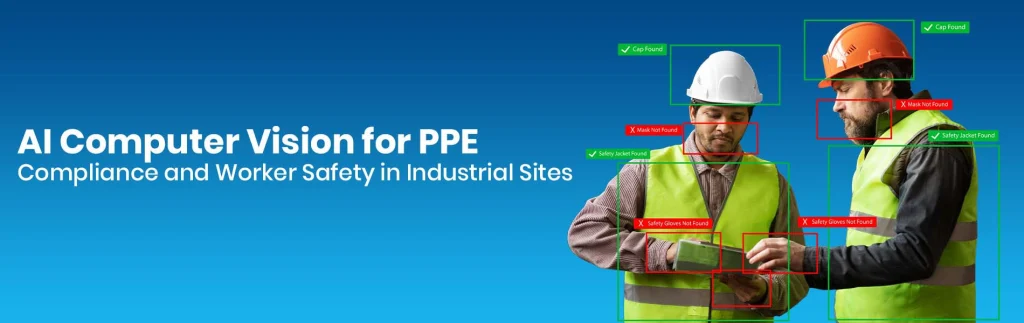
- PPE detection: Identifying missing helmets, vests, gloves, eye protection, safety shoes and other gear in defined zones.
- Unsafe act monitoring: Detecting behaviours such as running in restricted areas, phone use around moving machinery, or riding on forklift forks.
- Near-miss and hazard analytics: Tracking close calls between people and vehicles, or between workers and hazardous equipment.
- Restricted zone enforcement: Flagging entry into danger zones, vehicle-only lanes or exclusion areas around cranes and pits.
This is not about replacing safety professionals; it is about giving them a continuous, data-rich view they could never get via manual observation alone.
3. Why Safety Teams Are Turning to AI and Computer Vision
Three trends are pushing EHS and operations leaders toward AI video analytics.
3.1 Traditional Safety Monitoring Is Too Sparse
Safety rounds, audits and toolbox talks are essential, but they sample only a tiny fraction of actual behaviour. With hundreds of cameras running and thousands of micro-actions happening every hour, manual review quickly becomes impossible.
Global occupational safety data indicates that hundreds of millions of non-fatal injuries happen every year, which implies that near-misses and unsafe acts number in the billions. Trying to catch enough of those with human eyes alone is unrealistic.
3.2 EHS Tools Need Better “Eyes”
The EHS software market—used for incident reporting, audits, and compliance—is growing at roughly 10% per year, while the broader EHS market in major economies such as the US is already in the tens of billions annually. Yet most of these systems still rely on manual inputs: someone has to log the near-miss, file the corrective action, or upload the photo.
Computer vision gives EHS platforms an automatic, high-frequency data feed:
- PPE violations get logged as structured events.
- Heat maps show where unsafe acts cluster.
- Video snippets illustrate trends for training and investigations.
This is why vendors specialising in AI safety analytics are now partnering closely with EHS software providers: together they create a closed loop from detection to action.
3.3 Case Studies Prove the Impact
AI safety platforms are now mature enough that large enterprises are sharing concrete outcomes:
- Major retailers have reported double-digit percentage reductions in overall incidents in a matter of weeks at distribution centres.
- Global manufacturers have seen unsafe acts and conditions drop by 90% in the first six months after deploying AI-based safety analytics across multiple plants.
- Infrastructure projects using smart CCTV analytics have documented more than 70% reductions in manual patrolling requirements and strong improvements in safety monitoring accuracy.
These are not lab pilots; they are scaled deployments in real factories, DCs and construction megaprojects.
4. Real-World Case Studies: Named Enterprises, Measurable Results
4.1 Marks & Spencer: 80% Fewer Incidents and Better Near-Miss Reporting
Marks & Spencer (M&S), the British multinational retailer, introduced AI-driven health and safety technology from Protex AI at its large distribution centre in Castle Donington.
Within just ten weeks, M&S publicly reported:
- An 80% reduction in overall workplace incidents at the site.
- A 10% increase in near-miss reporting, indicating that workers were more willing and able to flag risks before they turned into injuries.
The deployment combines computer vision models that monitor behaviours and PPE use with analytics dashboards that help EHS teams focus on the riskiest zones and recurring patterns. For a high-throughput distribution centre, those numbers translate directly into fewer disruptions, less lost time and lower incident-related costs.
4.2 Leading Beverage Manufacturer (Japan): 90% Reduction in Unsafe Acts
A leading food and beverage manufacturer headquartered in Japan, operating more than 50 facilities and employing over 40,000 people, rolled out Intenseye’s AI workplace safety platform across multiple plants.
According to the published case study, within the first six months of using AI-driven safety insights:
- Unsafe acts and unsafe conditions were reduced by 90%.
The system uses existing cameras to detect PPE violations, blocked exits, improper line clearance and other high-risk situations. EHS teams receive prioritised alerts and trend reports, enabling them to focus interventions where they matter most.
4.3 Metro Construction in Doha (Qatar): AI for Perimeter and Safety Monitoring
On metro infrastructure projects in Doha, Qatar, construction stakeholders deployed viAct’s AI-powered video analytics for smart perimeter and safety monitoring.
Public materials from viAct highlight that this deployment achieved:
- Over 80% safety monitoring accuracy through smart conflict checks and automated detection of overlapping high-risk activities.
- Around a 70% decrease in manual patrolling requirements, freeing supervisors and safety officers for higher-value tasks such as coaching and root-cause analysis.
4.4 Leading Global Food Distributor: 76% Reduction in Area Control Risks
Protex AI also reports a case study with a leading global food distributor, where AI-powered video analytics was deployed in warehouses and cold chain facilities.
The result:
- A 76% reduction in what the company categorises as “area control risks”—events such as people entering restricted zones, vehicles operating in prohibited areas or unsafe co-location of people and equipment.
For a food distributor handling tight margins and strict safety regulations, cutting such risks by more than three-quarters is significant: it reduces the probability of serious harm and helps maintain compliance with food safety and occupational safety standards at the same time.
5. Key AI Use Cases for PPE and Worker Safety
For industrial plants, warehouses, logistics hubs and construction sites, the most common AI safety use cases fall into a few categories.
5.1 PPE Detection and Zone-Based Rules
- Detect missing helmets, high-visibility vests, safety glasses, gloves or safety shoes in defined “must-wear” zones.
- Differentiate PPE requirements by area: for example, face shields in welding bays, hearing protection near loud presses, and respirators in specific rooms.
- Escalate alerts when repeated violations occur in the same location or shift, so supervisors can intervene.
5.2 Unsafe Acts and Near-Miss Analytics
- Detect behaviours such as running in production areas, standing under suspended loads, riding on forklift forks or climbing racks.
- Track near-misses between vehicles and pedestrians at intersections or blind spots.
- Feed anonymised event data into dashboards, helping safety teams identify hotspots and trends rather than isolated incidents.
5.3 Vehicle and Pedestrian Interaction Monitoring
- Use overhead or side-mounted cameras to monitor forklift and truck routes.
- Trigger alerts when pedestrians enter designated vehicle-only zones or when forklifts exceed defined “comfort” speeds in mixed-traffic areas.
- Combine heat maps and dwell-time analysis to redesign routes and reduce conflict points.
5.4 Housekeeping and Hazard Detection
- Detect blocked fire exits, cluttered aisles, spills or obstacles in walkways.
- Support “5S” and housekeeping programs with automated visual checks rather than relying solely on manual audits.
5.5 Automated Safety Reporting and Training Content
- Automatically log safety observations and events into EHS platforms, complete with video snippets and anonymised metadata.
- Use curated clips from real events (with faces blurred as necessary) in toolbox talks and safety training, making lessons more concrete and site-specific.
Together, these use cases shift the safety program from sporadic checks to continuous, data-driven risk management.
6. Quantifying ROI: How Safety Leaders Can Make the Business Case
EHS and operations leaders are often convinced by the safety value of AI, but need a solid business case to secure budget. The numbers from real deployments point to several quantifiable levers:
1. Incident and injury reduction
Case studies show incident reductions in the 70–90% range for specific sites after AI safety rollouts. Even a smaller reduction in severe incidents can save substantial direct and indirect costs per year, including medical expenses, compensation, lost productivity and overtime.
2. Near-miss visibility and proactive interventions
When AI prompts better near-miss reporting (for example, a 10% improvement at a major distribution centre), organisations gain more leading indicators to act on. Catching problems at the near-miss stage is far cheaper than dealing with full incidents.
3. Reduced manual patrolling and inspection time
If AI monitoring cuts manual patrolling requirements by 70% on large sites, supervisors can spend more time on coaching, training and root-cause analysis instead of repetitive walks. That time saving can be quantified in labour hours and opportunity cost.
4. Regulatory and insurance benefits
Stronger safety performance supported by hard data can help demonstrate compliance with regulations and may improve an organisation’s standing with insurers, potentially influencing premiums or terms over time.
5. Cultural impact and employee trust
Consistently visible, fair enforcement and proactive intervention can boost workers’ perception that management is serious about safety. That is harder to price, but it correlates with lower turnover, better engagement and fewer “normalisation of deviance” patterns.
7. Implementation Roadmap for AI Safety and PPE Projects
Rolling out AI computer vision for safety is not just a technology upgrade; it is a change in how the organisation spots and manages risk. A pragmatic roadmap:
Step 1 – Baseline Safety Performance
- Compile recent data on recordable incidents, lost-time injuries, near-miss reporting rates, and PPE non-compliance observations.
- Identify high-risk zones: loading docks, welding bays, heavy assembly lines, crane areas, excavation pits, or high-traffic intersections.
Step 2 – Audit Cameras and Infrastructure
- Map existing cameras and their fields of view; identify where additional cameras might be needed.
- Check lighting conditions, network capacity and storage; decide where AI models will run (on edge devices, on-prem servers or in the cloud).
Step 3 – Choose an Initial Use Case and Site
- Start with a focused, high-impact use case such as PPE detection in one line, forklift–pedestrian interactions at key intersections, or entry into restricted zones.
- Select a site with strong safety leadership and openness to experimentation.
Step 4 – Define Clear Metrics
- Example metrics: percentage reduction in specific incident types, number of PPE violations detected and corrected, change in near-miss reporting volume, reduction in manual patrol time.
- Set target ranges based on external benchmarks (for example, aiming for 70–90% reduction in targeted unsafe conditions over a defined period).
Step 5 – Engage Workers and Safety Representatives
- Communicate transparently about what AI will monitor and why, including privacy protections and anonymisation where appropriate.
- Involve safety committees or worker representatives in reviewing alerts and tuning thresholds, so the system is seen as a safety partner rather than surveillance.
Step 6 – Integrate with EHS Systems and Processes
- Connect AI alerts to existing EHS workflows: incident logging, corrective actions, safety observations and audit trails.
- Train supervisors and EHS staff on new dashboards and event streams.
Step 7 – Scale and Standardise
- Once the pilot meets its targets, roll out across additional zones and sites.
- Standardise model versions, alert policies and governance across the network.
- Use insights from one site (for example, common forklift–pedestrian conflict patterns) to pre-empt similar issues elsewhere.
8. Where a Platform Like Objiq Fits in the Safety Ecosystem
A platform like Objiq can act as the foundational layer for AI-powered worker safety by:
- Centralising video data and annotation workflows so that safety and data teams can rapidly build and refine PPE and behaviour-detection models using site-specific footage.
- Supporting multiple safety use cases—PPE detection, unsafe-act monitoring, near-miss analytics, housekeeping checks—on a single computer vision infrastructure, rather than running separate point solutions.
- Integrating with EHS and OT systems via APIs to feed structured safety events into incident management, permit-to-work systems, and maintenance workflows.
- Providing governance and transparency through model versioning, performance dashboards and audit trails, helping organisations meet both safety and AI accountability expectations.
9. Key Takeaways for EHS, Operations and Plant Leaders
- The global burden of work-related harm remains extremely high, with millions of deaths and hundreds of millions of serious injuries each year.
- EHS and safety markets are growing because regulators, investors and workers all expect better visibility, accountability and prevention.
- AI computer vision is emerging as a practical way to monitor PPE use, unsafe acts, near-misses and hazardous conditions at scale—using many of the cameras sites already have.
- Real-world deployments at organisations such as Marks & Spencer, a leading Japanese beverage manufacturer, global food distributors and major infrastructure projects show incident and unsafe-condition reductions in the range of 70–90%, along with big cuts in manual patrolling.
- For a platform like Objiq, the opportunity is to sit at the centre of this ecosystem: turning raw video into structured safety intelligence that continually improves how organisations protect their people.